Short answer: An AI receptionist answers the calls you can't take, collects enough detail for you to call back properly, and hands awkward calls to a person. For a small firm, the first version should capture five things: what the caller needs, where the job is, how urgent it is, their name, and a working callback number. It should never quote prices, take card details, or pretend to be a person.
What an AI receptionist is for
A customer rings the number on your van, website or Google listing. You're on a job and can't answer. Instead of voicemail, an automated assistant picks up, asks a few short questions, and sends you a tidy note you can act on when you're free.
That is missed-call lead capture. It is different from outbound marketing, where software rings lists of people who haven't contacted you. Outbound automated marketing calls have strict consent rules in both the UK and the Isle of Man (covered briefly below). Answering someone who rang you is ordinary customer service.
A worked example
Here's how a good call might go for a joiner who's up a ladder when the phone rings. This is an illustration, not a client case.
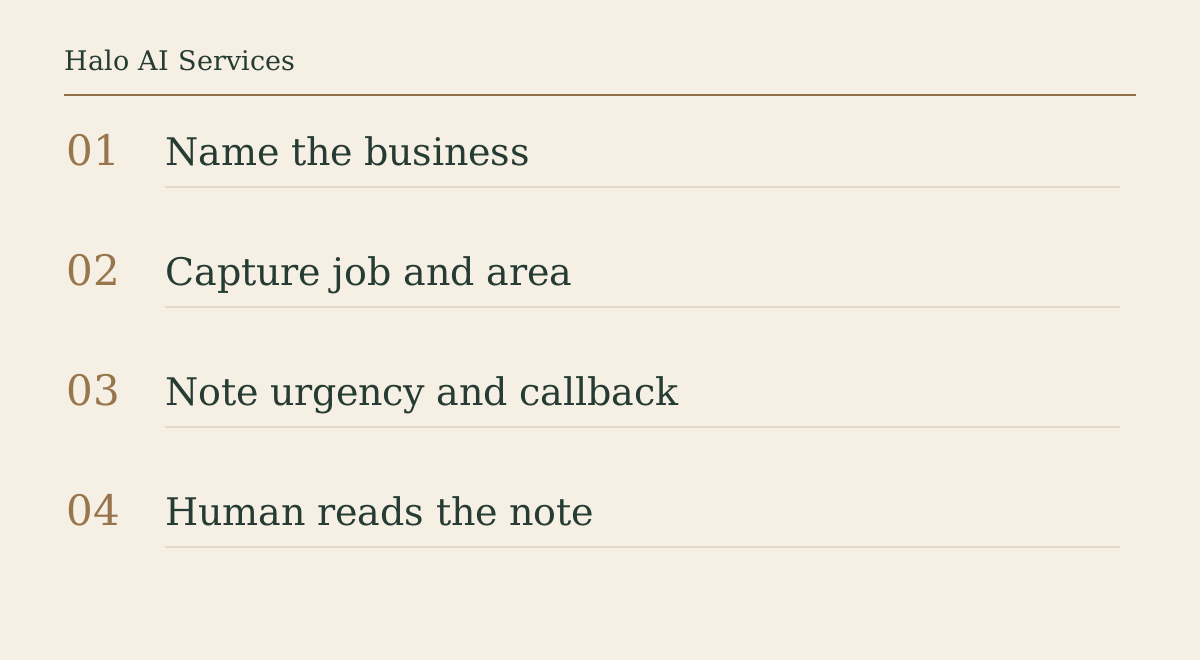
- The assistant gives the trading name, says it's an automated assistant, and explains that a person will read the message.
- It asks what the caller needs, in a sentence or two.
- It asks where the job is, and only confirms areas the joiner actually covers.
- It asks whether it's urgent. If someone is in danger, or it's a gas or electrical emergency, it tells them to call the emergency services or the right helpline.
- It takes a name and callback number, and reads the number back.
- It doesn't give a price, a same-day promise or a finish date.
- It sends the note to wherever the joiner actually looks during the day, such as a text or WhatsApp.
- The joiner rings back with the details in front of him. From there, a follow-up routine can take over.
If the caller asks for a person and nobody is available, the assistant should say so honestly and take a message.
What to capture, and what to leave out
Keep the script short enough that someone on a noisy street will finish it.
Capture:
- What they want, in their own words.
- Town, area or postcode.
- Urgency, using categories you define, for example "emergency", "this week" or "just getting quotes".
- Name and callback number.
- Time of the call, and which number they rang if you have more than one.
- Whether they asked to speak to a person.
Leave out:
- Card or bank details and passwords.
- Medical details, safeguarding concerns or neighbour disputes. Take a message and stop.
- Prices, unless you have a fixed list. If the price depends on seeing the job, say a visit or photos will be needed.
- Long surveys. Every extra question loses callers who only wanted to know if you cover their area.
Send notes to the inbox or app you already check, and ask the same core questions on your website enquiry form so phone and web enquiries land in one queue.
What callers should hear
- The business name first, then that they're speaking to an automated assistant.
- What happens next, using a timescale you can keep. "We'll call you back this afternoon" is fine; "in five minutes" isn't if you're driving until six.
- That the call is recorded, and why, if you keep recordings or transcripts. The ICO's call monitoring guidance says callers should be told about recording and its purpose. A transcript is personal data, so explain it in your privacy notice too. Isle of Man businesses should check the position with the Isle of Man Information Commissioner.
When a person must take over
Have the assistant hand over or take a message and stop when:
- the caller asks for a person;
- it has misunderstood twice;
- it's a complaint, refund request or accusation;
- someone may be unsafe, or it's a gas, fire, flood or electrical emergency;
- the caller describes a health, legal or personal matter;
- the only honest next step is a visit or written quote;
- the caller goes silent.
Healthcare, legal, financial and safeguarding calls need specialist scripts and review. A dentist's missed-call line is not a joiner's.
The rules in brief
This is a summary, not legal advice.
- Automated marketing calls (software ringing many numbers and playing a recorded message) need specific consent: in the UK under PECR regulation 19, and on the Island under regulation 2 of the Unsolicited Communications Regulations 2005. An inbound assistant doesn't do this, but some platforms can, so check what's switched on.
- Follow-up texts: a text saying "we've got your message and will call this number" is part of handling their call. Adding offers or newsletters makes it marketing, which generally needs consent under PECR in the UK and regulation 5 of the Island's regulations. The ICO's guidance and the Isle of Man Information Commissioner's guide explain the details.
- "Don't call me again": record it, and keep a do-not-contact list. People have a right to object to direct marketing.
Write down which tool you use, what it stores and who reviews transcripts in your AI policy.
How to test before signing a long contract
Write down five to ten real missed calls from your own phone, such as a wrong number, "are you still trading?", a genuine job, a complaint and an emergency. Run them through the assistant, or ask the vendor for test calls with you listening.
Check four things:
- Could you act on each note without ringing back to ask the same questions?
- Did it hand over or stop when it should have?
- Did it promise anything untrue, such as a price, area, arrival time or a named staff member?
- Would a caller have known they were talking to software?
If it made a single untrue promise, stop the pilot. A fluent assistant that invents prices is worse than voicemail. For costs and payback, use our AI receptionist ROI guide.
Red flags in a vendor pitch
- Claims that every missed call is a lost job, or that you'll win back a set percentage.
- Payback periods or "hours saved" figures with no evidence from businesses like yours.
- Presenting the assistant as a member of staff, an adviser or a replacement for emergency services.
- "GDPR ready" offered as if it settles marketing rules or your privacy notice.
- Defaults that promise same-day callbacks or 24-hour cover you don't actually provide.
Where Halo fits
Halo builds AI receptionists and lead response with qualification and human escalation built in. If you have a number, a rough idea of the script and a week of missed calls you can describe, the free audit is a good first step.
FAQ
Is an AI receptionist the same as an automated marketing call?
No. Answering an inbound call from someone who rang you is different from software that calls many numbers and plays a recorded marketing message. That second pattern needs specific consent under UK PECR regulation 19 and the Isle of Man Unsolicited Communications Regulations 2005. Check your platform, as some do both.
What should the first version capture?
The job in the caller's words, the area, how urgent it is, their name, a callback number and the time of the call. Leave out payment details and any price you haven't worked out.
Do I have to tell callers the voice is automated?
You should. It's honest, it builds trust, and if you record calls the ICO expects you to tell callers about the recording and why. Say it in the first sentence.
Can I text a discount after a missed call?
Treat that as marketing, which generally needs consent under UK PECR and the Isle of Man regulations. A simple "we've got your message and will call this number" text is the safer option.
Does it replace voicemail?
It can, if the notes are clearer than voicemail and someone reads them promptly. Test it on your own missed calls before committing.
Where are the costs and payback figures?
In the AI receptionist ROI guide, which sets out the cost comparison with clearly labelled example figures.
Related guides
Sources
- ICO, telephone marketing and automated calls.
- ICO, live marketing calls and the right to object.
- ICO, call monitoring and telling callers.
- UK legislation, PECR regulation 19.
- Isle of Man Information Commissioner, Unsolicited Communications Regulations.
- Isle of Man legislation, Unsolicited Communications Regulations 2005.
- Isle of Man Government, Information Commissioner.